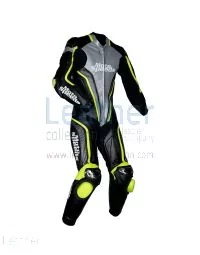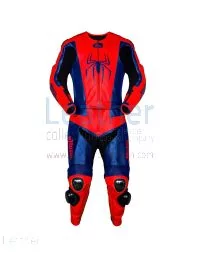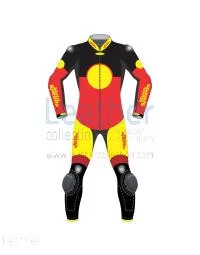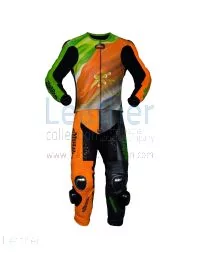
 USA
USA  Canada
  Brazil
  Germany
  France
  Italy
Italy  Switzerland
  Sweden
  Spain
Spain  Great Britain
  Russia
  South Africa
  Japan
Japan  New Zealand
  Australia
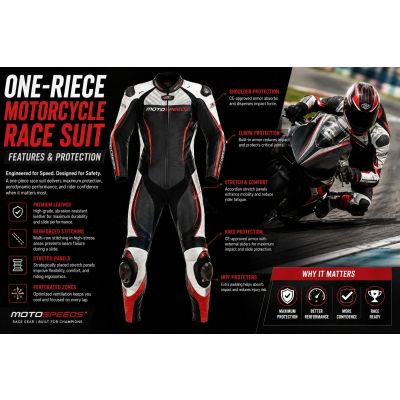
A one-piece motorcycle race suit is a single protective garment that covers torso, arms and legs. With no gap at the waist, a one-piece suit can help keep armor aligned over shoulders, elbows, knees, hips and back, though fit decides whether it does. This guide explains what the suit is made of, how the safety standards describe it, how it should fit and when it makes sense over separate jacket and pants.
Key Takeaways
- A one-piece suit has no waist gap, which can help keep armor aligned, though fit decides whether it does.
- EN 17092 classes the abrasion, tear and seam performance of the outer shell; AAA is the highest class.
- EN 1621 covers the armor itself: Level 2 limb protectors transmit less force than Level 1 in the standard's test.
- Fit decides whether armor stays over the joints: snug when standing, no bunching or pulling in the riding position.
- Track days, club racing and sportbike riding suit a one-piece; city commuting often suits separate pieces better.
Quick Answer: What Is a One-Piece Motorcycle Race Suit?
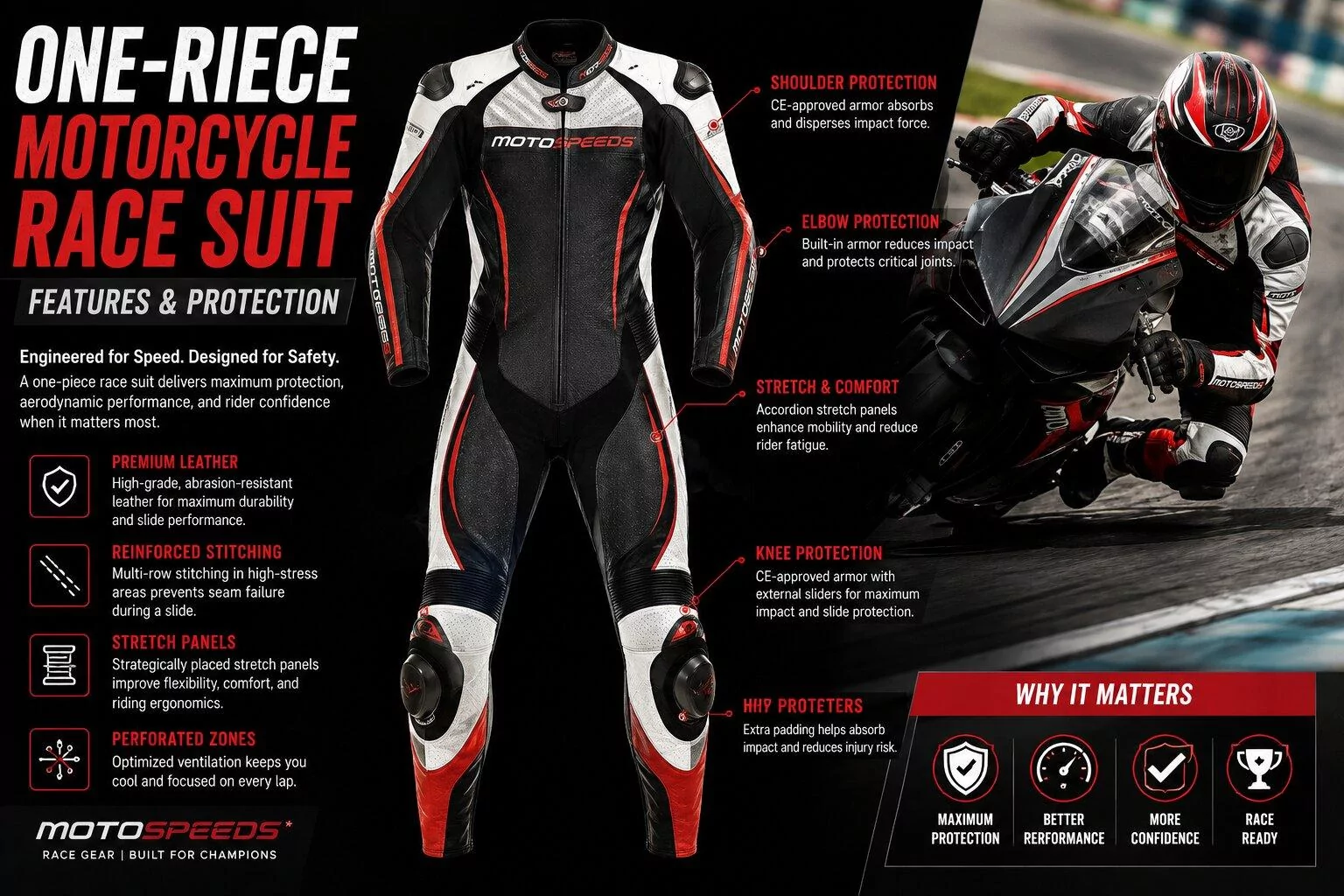
A one-piece race suit combines a leather (or leather and textile) shell with armor at the impact zones: shoulders, elbows, knees, hips and back. The cut is tight to reduce flapping at speed. The suit is designed for track riding and fast road riding, where crashes involve long slides at high speed.
In This Guide
- Why a one-piece suit matters on track
- How the standards describe protection
- Fit, comfort and armor position
- Construction features to check
- Common buying mistakes
- When to choose a one-piece suit
- Frequently asked questions
Why a One-Piece Suit Matters for Rider Safety
Track and sportbike riding involve higher speeds and deeper lean angles than city riding. When a rider slides, the shell meets the tarmac within a fraction of a second, so the protective layers need to stay where they are.
The main advantage is continuity. A separate jacket and pants meet at the waist, where a gap can open. A one-piece suit has no waist gap, which can help keep armor aligned with the joints it covers, though fit decides whether it does. Riders who work through the full range of will find this layout on almost every track-oriented model.
The shell is usually thick leather, which resists abrasion while the armor underneath spreads and reduces impact force. Neither removes the risk of injury: speed, surface, crash angle and body position all affect the outcome.
How the Standards Describe Protection
In a slide three things happen almost at once: the shell makes contact with the road, friction creates heat and abrasion, and the body takes impact from the ground or anything in the way. Separate standards cover each part.
Abrasion, tear and seam strength (EN 17092). This standard tests the shell of the garment. According to testing body SATRA, abrasion is assessed on the Darmstadt machine, which simulates a rider sliding from variable speeds to a stop, and the standard also sets requirements for tear and seam strength. Garments fall into classes AAA, AA, A, B and C. Class AAA is described as providing the highest level of protection from impacts and abrasion, AA covers the greatest diversity of riding, A is aimed at the least ergonomic and weight penalty, B matches the abrasion performance of A without impact protectors, and C only holds protectors in place. The class printed on the label says more about the shell than the word "race" in a product name.
Impact protection (EN 1621). Armor is tested separately. EN 1621-1 covers protectors for limb joints such as elbows, shoulders, knees and hips, and EN 1621-2 covers back protectors. As summarized by Wikipedia, limb protectors at Level 1 must keep the mean below 35 kN with no single value over 50 kN, and Level 2 the mean below 20 kN. A lower figure means less force reaches the body in the test. It does not mean an injury is prevented.
Seams. Seam failure lets the layers separate, which is why seam strength is part of the shell rating and why multiple rows of stitching are common on race suits.
Protective gear reduces risk; it does not remove it. Riding speed, road condition and impact angle still decide how a crash ends, and rider skill and awareness remain part of the picture.
Fit, Comfort and Armor Positioning
Fit is where many buyers go wrong. A suit that is too loose lets the shell bunch and the armor drift off the joint. A suit that is too tight restricts movement and can compromise riding posture and control.
The target is snug but not restrictive. Standing upright, the suit feels firm against the body. Bent into the riding position, it moves with the rider without pulling at the shoulders or riding up at the knees. Elbows should bend smoothly and the armor should sit centered over each joint.
Riders between standard sizes, or with a longer torso, shorter arms or wider shoulders, often find that off-the-rack sizing leaves gaps or pressure points. Made-to-order sizing exists for that reason: measurements decide where seams and armor end up, not a size label. Riders comparing related protective gear can look at
for options organized by fit and riding use.Heat is the usual trade-off. Perforated leather and mesh panels improve airflow in summer, while heavier shells are warmer. The choice depends on climate and ride length, but in either case the suit has to stay in position and keep the armor in place.
Construction Features to Check
Leather and thickness. Full-grain leather is common on the seat, shoulders and elbows. Thicker leather resists abrasion for longer but is stiffer, so many suits use thicker hide on slide zones and thinner, more flexible leather at the waist and inner arm. Product details should say which grades are used where.
Armor placement. Shoulders, elbows, knees, hips and back should be covered, with some suits adding chest protection and palm sliders. Check the alignment in the riding position; misaligned armor does not cover the joint it was designed for.
Stretch panels. Gussets at the underarms, inner thighs and waist add mobility without leaving the body exposed.
Stitching. Look for multiple rows at stress points such as the crotch, underarms and neck. Multiple rows hold better than a single line.
Sliders. Hard plastic or composite sliders on knees, hips and elbows are optional and widely used on track.
Zippers and hardware. Zips should run smoothly and lock securely. Hardware should resist corrosion for wet-weather use.
Common Mistakes When Buying a Race Suit
Choosing by street-clothes size. Race suits are cut tighter through the torso and longer in the arm. Trying one on is more reliable than ordering by usual size; if ordering remotely, compare the size chart to a garment that already fits.
Ignoring the labels. Armor without an EN 1621 label gives no evidence it has been tested. Check for EN 1621 armor and confirm whether it is Level 1 or Level 2. Check also which EN 17092 class the shell carries.
Assuming price equals protection. A more expensive suit often has better materials and fit options, but a correctly fitted suit with armor labeled to EN 1621 protects better than a poorly fitting one.
Skipping care and inspection. Follow the maker's care instructions; the right care depends on the finish and construction. After a crash, the suit should be inspected by a qualified repair shop even if it looks intact, because torn seams and damaged armor reduce protection.
When to Choose a One-Piece Suit
A one-piece suit is worth considering in these cases:
- Regular track days or club racing, where speeds are high and lean angles are consistent.
- Sportbike riding on the road with a fast, aggressive style.
- A previous crash or close call where a jacket rode up or the armor shifted.
- Current gear that no longer fits or has worn-out armor.
City riding at moderate speeds with frequent stops is different. Separate pieces are easier to take on and off, and some riders prefer , where the jacket and pants join with a connecting zip. For track work, many riders compare these with before deciding.
Conclusion
A one-piece suit is built around alignment: shell, seams and armor stay in one piece over the joints. How well it protects depends on the labels (EN 17092 class and EN 1621 level), the fit and the way it is maintained. For riders who want to see how these features come together in a real garment,
is one example of construction, fit and protective features in one design.Frequently Asked Questions
Can a one-piece race suit be worn for street riding?
Yes, although it is cut for the track. The tight fit helps armor stay in place, but it is less convenient for daily commuting, where a separate jacket and pants are easier to remove off the bike. Sportbike riders on fast road rides often accept the trade-off in comfort for better armor retention.
What is the difference between a race suit and a riding jacket?
A race suit is one connected garment with armor throughout, so there is no waist gap. A jacket is a separate piece with a join at the waist. Race suits are also cut tighter and use thicker shell materials, while jackets are usually easier to wear every day.
Is Level 2 armor necessary, or is Level 1 enough?
Under EN 1621-1, Level 2 limb protectors transmit less force than Level 1 in the lab test: Level 2 requires a mean below 20 kN , Level 1 a mean below 35 kN with no single value over 50 kN. Choose by budget, comfort and use, and check the label on the suit, which states which level is fitted.
How can a rider tell whether a race suit fits correctly?
It should feel snug when standing and move with the body when leaning into the riding position, without pulling or bunching. Armor should sit centered over the joints, and no seam should create a pressure point. Gaps where armor should be, or pinching in the shoulders and knees, signal that the size or cut is wrong.
What should be done with a race suit after a crash?
Inspect it for torn seams, separated armor and cracks in protectors. Light scuffs on the shell are normal, but damaged seams or armor should be checked by the maker or a qualified leather repair shop. A suit that has been through a crash should not be assumed to give full protection again without inspection.
Written by the Leather Collection Editorial Team.