
 USA
USA  Canada
  Brazil
  Germany
  France
  Italy
Italy  Switzerland
  Sweden
  Spain
Spain  Great Britain
  Russia
  South Africa
  Japan
Japan  New Zealand
  Australia
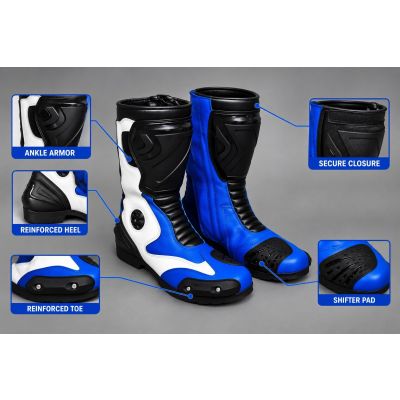
You're standing in front of a dozen pairs of motorcycle boots, and they all look similar. One has a shifter pad. Another promises "racing-grade protection." A third costs half the price of the others. You need to know which features actually keep your feet and ankles safe during a crash, which ones are marketing hype, and whether you should buy standard sizes or invest in custom boots that match your riding suit.
Motorcycle racing boots are not casual footwear. They're engineered protection devices that sit between your feet and the ground during a high-speed slide or impact. The right boots absorb energy, resist abrasion, keep your ankle stable during a crash, and stay in place when your body slides across asphalt. The wrong boots shift on impact, leave your ankles vulnerable, or feel so restrictive that you adjust your foot position to be more comfortable — which means less protection.
Your feet endure extreme forces during a motorcycle crash. A slide at 60 mph generates friction temperatures that can melt unprotected skin. Your ankles can twist or break if they lack reinforcement. Your toes can be crushed or scraped away if the boot material is thin or poorly constructed. Choosing the right motorcycle racing boots means understanding what protection matters, what your riding style demands, and how to fit boots so they stay protective without compromising your ability to control the bike.
Quick Buying Advice:
Motorcycle racing boots must have reinforced ankle support, oil-resistant soles, abrasion-resistant leather (at least 1.0 mm thickness), and a secure closure system that won't loosen during a crash. Buy boots that fit snugly around your heel and midfoot with minimal movement — not tight enough to restrict circulation, but not loose enough to shift. If your boots feel uncomfortable after five minutes of walking, they will feel worse after five hours on the track. Standard sizing works for most riders; custom boots are worth considering only if your feet fall outside typical proportions or you're matching a custom racing suit.
- What Should Riders Know Before Buying Motorcycle Racing Boots?
- How to Choose Boots Based on Your Riding Style
- What Safety Features Should Buyers Check?
- How Fit and Sizing Affect Comfort and Protection
- Which Materials and Construction Details Matter?
- Standard Size vs Custom Size: Which Should You Choose?
- Final Buying Advice from Leather Collection
What Should Riders Know Before Buying Motorcycle Racing Boots?
Motorcycle racing boots serve one primary purpose: to protect your feet and ankles during a crash or high-speed slide. Unlike street boots that balance protection with everyday wearability, racing boots prioritize protection even when that means less comfort during normal riding. Your feet are the foundation of your connection to the bike, and an injury to your ankle, foot, or toes can end your riding season or cause permanent damage.
Most riders underestimate foot and ankle injuries. A slide at even modest speeds generates friction that can strip away skin, melt synthetic materials, and subject your foot to shearing forces that twist or break bones. Your ankle, which contains 26 bones and dozens of small ligaments, is particularly vulnerable. An ankle that twists during a crash without proper support can suffer sprains, fractures, or ligament tears that take months to heal and may never regain full strength.
Racing boots differ fundamentally from casual motorcycle boots or street riding boots. Racing boots have reinforced ankle collars, multiple layers of protection at impact zones, oil-resistant soles designed not to slip on track surfaces, and closure systems that lock down tight enough to prevent any movement during a crash. They're designed to stay in place during a slide, not just while you're riding upright on the bike.
The level of protection you need depends on your riding style, typical speeds, and whether you're riding on track or street. A club racer who spends weekends at the track needs different boots than a sportbike commuter who occasionally pushes hard on backroads. A beginner learning on track needs boots that protect aggressively because crashes are more likely. An experienced track day rider can choose boots optimized for their specific use case.
How to Choose Boots Based on Your Riding Style
Your riding style determines what level of protection and what specific features matter most in your racing boots. A track-day rider, a club racer, and a street sportbike rider have different needs, and choosing boots that don't match your actual riding will either waste money on unnecessary protection or leave gaps in safety.
If you ride on track regularly — whether club racing or organized track days — you need racing boots designed specifically for that environment. Track riding involves sustained lean angles, high speeds, and the real possibility of a low-side crash where your foot and ankle hit the ground while the bike is still moving. You need boots with reinforced ankle support rated for impact, aggressive tread or grip soles designed for track surfaces, and materials that resist abrasion. One-piece boots that extend high on your leg offer better ankle stability and protection than lower-cut designs. Look for boots with CE ankle protection (EN 1621-2 certified ankle armor) and reinforced toe and heel areas.
If you're a sportbike street rider who occasionally visits the track or rides aggressively on roads, you need boots that balance protection with everyday wearability. You'll be shifting gears, walking around, and wearing them for extended periods. A mid-height boot with reinforced ankle support, a shifter pad, and abrasion-resistant leather works well. You don't need the extreme ankle height of a racing boot, but you do need genuine impact protection, not just style. Choose boots with at least 1.0 mm leather thickness and sealed seams to resist water and road spray.
If you're a beginner buying your first pair of motorcycle boots, prioritize ankle support and snug fit over style or brand name. Your crashes are more likely, so protection matters more than aesthetics. Choose a boot that fits your foot shape naturally — not a boot you're trying to grow into or a trendy brand that's uncomfortable. A comfortable boot is a boot you'll actually wear, and a boot you wear is infinitely safer than a protective boot sitting in your closet because it hurt your feet.
What Safety Features Should Buyers Check?
Motorcycle racing boots must have specific safety features to protect your feet and ankles during a crash. These features are not optional upgrades — they're the foundation of what makes a boot suitable for racing or high-performance riding.
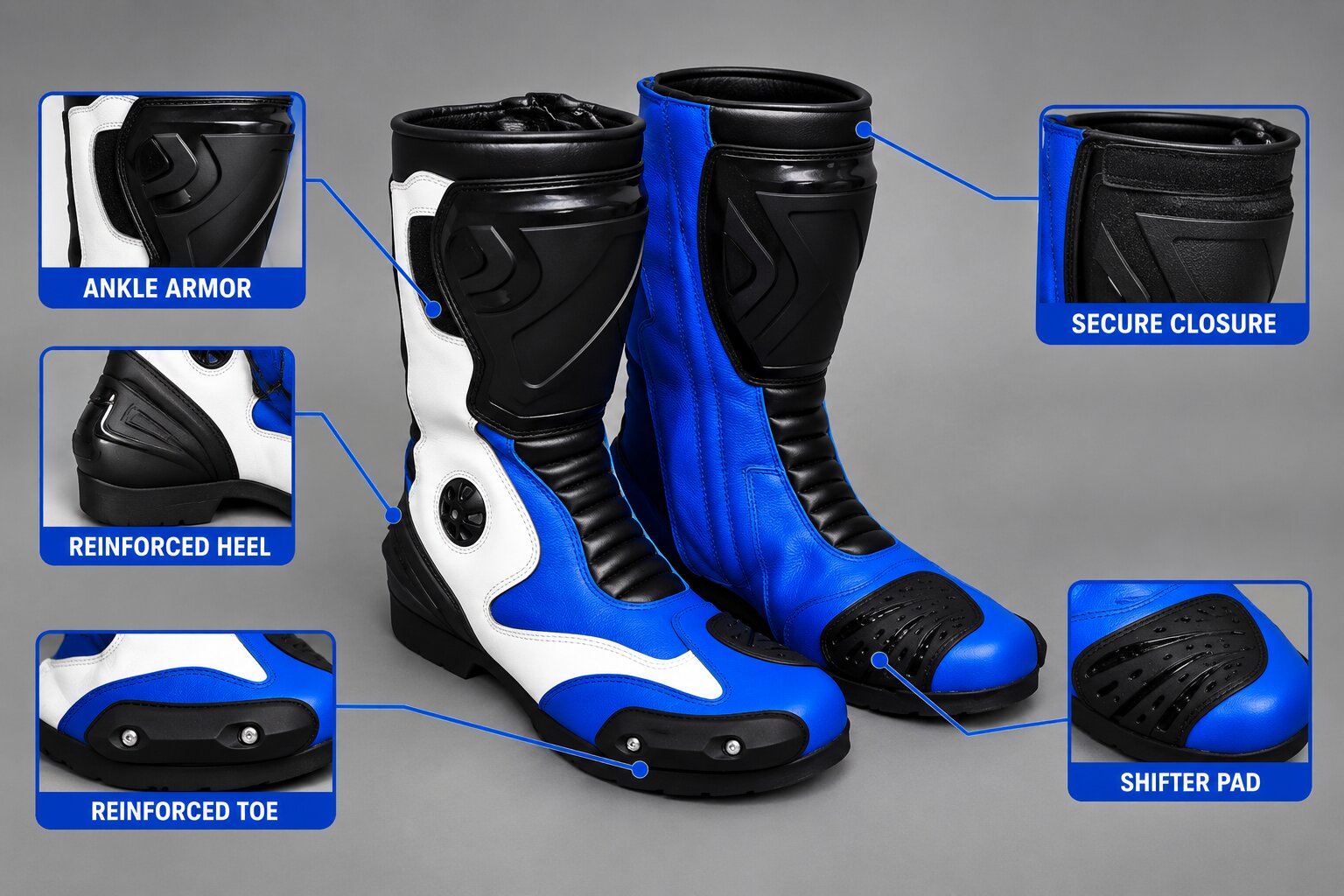
Ankle armor is the most important safety feature. Look for boots with CE-certified ankle protection (EN 1621-2 standard), which means the armor has been tested to absorb impact energy at a defined level. CE Level 1 ankle armor absorbs 35 kJ of impact energy; Level 2 absorbs 50 kJ. For track riding, Level 2 is worth the investment because your crashes are more likely and occur at higher speeds. The armor should be positioned to protect the outer ankle bone (lateral malleolus), the inner ankle bone (medial malleolus), and the ankle joint itself. Armor that covers only one side of your ankle leaves you vulnerable if you crash on the opposite side.
Heel and toe reinforcement protects the areas most likely to impact the ground during a slide. Your heel and toes experience the first contact with the road surface, and they absorb tremendous friction and shearing forces. Boots should have reinforced heel cups — either double-stitched leather or a rigid heel counter that prevents your heel from moving inside the boot. Toe reinforcement can be a thickened leather cap, a rubber toe guard, or a combination of both. Check that the toe reinforcement extends far enough to cover your entire toe area, not just the very tip.
Shifter pad protection is essential if you shift with your left foot (standard on motorcycles). The shifter pad should be reinforced leather or a durable synthetic material that resists scuffing and abrasion. During a crash, your foot may drag across the ground, and the shifter pad takes the brunt of that friction. A thin or poor-quality shifter pad will wear through quickly and won't protect your foot during a slide. Check that the shifter pad is at least as thick as the rest of the boot leather and that it's glued and stitched securely.
Oil-resistant soles are critical for track riding. Standard rubber soles become slippery on oil, fuel, or coolant spilled on the track. Racing boots have soles made from oil-resistant rubber compounds that maintain grip even on contaminated surfaces. If you're buying boots for track use, verify that the sole is oil-resistant. Street boots often use standard rubber that's not rated for oil resistance.
Closure systems must lock your foot down securely without cutting off circulation. Velcro straps, lace-up systems, and buckles all work, but they must be easy to adjust while wearing gloves and secure enough that they won't loosen during a crash or vigorous riding. A boot that feels snug when you first put it on but loosens as you ride is a boot that will shift during a crash. Test the closure by putting on the boot, tightening it, then trying to pull your foot out slightly without loosening the straps. If your foot moves at all, the boot is too loose.
How Fit and Sizing Affect Comfort and Protection
Fit is where most riders make expensive mistakes. A boot that looks right and has all the right safety features is useless if it doesn't fit your foot properly. Poor fit causes two problems: it reduces protection because the boot shifts during a crash, and it reduces comfort because your foot is working against the boot instead of working with it.
When you try on racing boots, they should feel snug immediately — not painfully tight, but not loose. Your heel should not move inside the boot when you walk or shift your weight. Your midfoot should feel supported without the boot digging into the sides of your foot. Your toes should have enough room to wiggle slightly, but not enough to slide forward when you brake hard. If you can fit a finger between your heel and the back of the boot, the boot is too loose. If you can't fit your pinky finger between your toes and the front of the boot, the boot is too tight.
Many riders buy boots that feel uncomfortable during the first try-on and assume they'll "break in." Racing boots don't break in significantly. Leather softens slightly with time, but if a boot hurts your foot when you first wear it, it will hurt your foot after ten hours of riding. The only exception is a very stiff closure system that loosens slightly, but the actual boot structure doesn't change much. If a boot is uncomfortable in the store, it will be uncomfortable on the track.
Walk around in the boots for at least five minutes before buying. Put them on, walk across the store, shift your weight, and simulate the foot movements you make while riding. Does your heel lift? Does your arch feel supported? Do your toes feel cramped? Do the straps dig into your foot? These sensations will only be amplified during riding. A boot that's mildly uncomfortable in the store becomes painful after an hour on the bike.
Common sizing mistakes happen when riders buy boots that are too large or too small. Boots that are too large shift during riding and during a crash, which means the armor won't stay in place over your ankle. Boots that are too small restrict blood flow, cause foot fatigue, and force you to adjust your foot position to be more comfortable — which means you're no longer in the optimal riding position. Both mistakes reduce safety.
If you're between sizes, choose the smaller size and verify the fit carefully. A slightly snug boot is safer than a slightly loose boot. Loose boots shift; snug boots stay in place. If the smaller size causes pain or restricts circulation (your foot feels numb or tingly after a few minutes), then the larger size is correct — but that's rare. Most riders can wear a snug boot comfortably for hours if the boot is designed well and fits their foot shape.
Your foot swells slightly during riding due to increased blood flow and heat. A boot that fits perfectly when you first put it on may feel slightly tighter after thirty minutes of riding. This is normal. The boot should still feel secure but not painfully tight. If a boot feels too tight after warming up, it was too tight to begin with.
Which Materials and Construction Details Matter?
The materials and construction of your racing boots directly determine how long they'll protect you and how well they'll perform during a crash. Cheap boots might look similar to quality boots, but the materials and construction methods are vastly different.
Leather thickness is the most important material specification. Racing boots should use leather that's at least 1.0 to 1.3 mm thick. Thicker leather provides better abrasion resistance and takes longer to wear through during a slide. Cowhide at 1.2 mm thickness is the standard for quality racing boots. Kangaroo leather is lighter and stronger per millimeter than cowhide, but it's more expensive and less widely available. If a boot doesn't specify leather thickness, ask the manufacturer. Boots made from thin leather (under 1.0 mm) or bonded leather (leather scraps glued together) will not provide adequate protection during a high-speed slide.
Stitching and seam reinforcement prevent your boot from falling apart during a crash or after extended use. Quality racing boots use double-stitched seams in high-stress areas like the ankle collar, heel, and toe. The stitching should be tight and even with no gaps between stitches. Cheap boots use single-stitched seams that fail quickly. Check the seams by flexing the boot and looking for any separation between the leather pieces. If you can see light through a seam, the boot is poorly constructed.
The sole construction affects both safety and durability. Racing boots should have oil-resistant soles that are glued and stitched (not just glued) to the upper. A sole that's only glued will separate during hard use or a crash. The sole should be thick enough to resist punctures — at least 4–5 mm of rubber. Thin soles wear through quickly and offer less protection from sharp objects on the road or track.
Lining materials affect comfort and durability. Quality boots use breathable linings (often mesh or perforated leather) that allow sweat to evaporate. Cheap boots use plastic or non-breathable linings that trap moisture, causing blisters and foot odor. If you're buying boots for summer track days or warm climates, a breathable lining is essential.
When is it worth paying more for boots? If you ride on track regularly, the answer is yes. A quality pair of racing boots costs $300–$600, while cheap boots cost $100–$150. The difference in protection, comfort, and durability is substantial. Quality boots protect better, last longer, and feel better during extended riding. If you ride on track once or twice a year, you might choose mid-range boots ($200–$300) that balance protection with cost. If you ride on street only, you can choose street-focused boots that cost less because they don't need extreme racing protection. But don't choose a cheap boot thinking it will protect you like an expensive one — it won't. Protection costs money because it requires better materials, better construction, and better testing.
Standard Size vs Custom Size: Which Should You Choose?
Most riders fit standard boot sizes well and don't need custom boots. Custom boots are worth considering only if your feet fall outside typical proportions or if you're matching a custom racing suit that requires coordinated sizing.
Standard sizing works if your feet are within typical ranges for your shoe size. If you wear a men's size 10 shoe, you'll likely fit a men's size 10 racing boot. Manufacturers design standard boots around average foot proportions, and most riders fall into that range. Standard boots are less expensive (typically $300–$500) than custom boots and are available immediately or with short lead times.
Custom boots are worth ordering if you have non-standard foot proportions. If your feet are particularly wide or narrow, if you have high or low arches, or if your proportions don't match standard size charts, custom boots will fit better and protect better. Custom boots also make sense if you're building a matching racing suit, gloves, and boots ensemble where color, material, and fit need to coordinate. A custom boot can be made to match your suit's leather type, color, and construction details.
Custom boots take longer to receive (typically 4–8 weeks) and cost more (typically $500–$800). You'll need to provide detailed measurements and possibly send a tracing of your foot. The fit is usually superior to standard boots, and you get exactly what you want in terms of materials, colors, and construction. If you're serious about track riding and plan to use the boots for multiple seasons, custom boots are an investment that pays off in comfort and protection.
To decide between standard and custom, start by trying on standard boots from multiple manufacturers. If you find a pair that fits well, feels comfortable, and has the protection features you need, buy the standard boots. If you try on multiple standard boots and none of them fit your foot shape well — if they're consistently too wide or too narrow, or if the heel cup doesn't match your heel shape — then custom boots are worth considering.
Final Buying Advice from Leather Collection
Choosing motorcycle racing boots comes down to three decisions: protection level, fit, and materials. Get these right, and you'll have boots that protect you effectively and feel good during hours of riding. Get them wrong, and you'll have boots that sit in your closet because they're uncomfortable, or boots that fail to protect you when you need them most.
Start by defining your riding style and typical speeds. Track riders need maximum ankle protection and aggressive abrasion resistance. Street sportbike riders need good ankle support and shifter pad protection with slightly more comfort. Beginners need snug fit and reliable ankle support above all else. Once you know what you need, you can evaluate boots against those criteria instead of being swayed by brand names or aesthetics.
Next, prioritize fit over everything else. Spend time trying on boots. Walk around. Simulate riding movements. If a boot doesn't feel right in the store, it won't feel right on the bike. A comfortable, well-fitting boot is infinitely safer than a protective boot that's uncomfortable because you'll actually wear it and your foot position will be optimal.
Check the specific safety features: ankle armor rated to CE Level 2, reinforced heel and toe, oil-resistant sole, and a secure closure system. Verify that the leather is at least 1.0 mm thick and that seams are double-stitched. These details are what separate boots that protect you from boots that just look protective.
Decide whether standard or custom boots make sense for your situation. Most riders should start with standard boots from a reputable manufacturer. If standard boots don't fit well after trying multiple brands, then custom boots are worth the investment.
Finally, don't cheap out on foot protection. Your feet are your connection to the bike and your foundation for control. Boots are one of the few pieces of gear where the protection difference between a $150 boot and a $400 boot is dramatic and measurable. A quality pair of racing boots will last multiple seasons and protect you far better than budget alternatives.
When you're ready to compare boots that meet these criteria, our
includes racing boots designed for track protection, custom sizing, and fit that matches your foot shape and riding style.For riders who want to build a complete matching gear package, the
shows how racing boots work together with a racing suit to provide coordinated protection and a custom fit that works across your entire body.FAQs
What CE armor level do I need in motorcycle racing boots?
CE Level 2 ankle armor is the standard for track riding because it absorbs more impact energy (50 kJ) than Level 1 (35 kJ) under the same test conditions. If you race or ride on track regularly, Level 2 is worth the extra cost. If you ride street only, Level 1 is adequate. Verify that the armor is positioned to protect both the outer and inner ankle bones, not just one side.
How tight should motorcycle racing boots fit?
Racing boots should fit snugly with minimal heel movement but without restricting circulation. Your heel should not lift inside the boot when you walk, and your midfoot should feel supported. Your toes need enough room to wiggle but not enough to slide forward. If a boot is uncomfortable during the first try-on, it will be uncomfortable after hours of riding — boots don't break in significantly. Wear the boots for at least five minutes in the store before deciding.
What leather thickness do racing boots need?
Motorcycle racing boots should use leather that's at least 1.0 to 1.3 mm thick. Cowhide at 1.2 mm is the standard for quality racing boots and provides good abrasion resistance during a slide. Kangaroo leather is stronger per millimeter but more expensive. Boots made from leather under 1.0 mm or from bonded leather will not provide adequate protection during a high-speed slide. Always ask the manufacturer for leather thickness specifications.
Should I buy custom racing boots or standard sizes?
Most riders fit standard boot sizes well and should start there. Standard boots are less expensive and available immediately. Custom boots are worth ordering only if your feet are non-standard proportions (very wide or narrow, unusual arch height) or if you're matching a custom racing suit. Custom boots take 4–8 weeks and cost more, but they fit better if your foot shape doesn't match standard sizing.
Why do oil-resistant soles matter for track boots?
Track surfaces can have oil, fuel, or coolant spilled on them, and standard rubber soles become dangerously slippery on these substances. Oil-resistant rubber maintains grip even on contaminated surfaces, which is critical for safety during braking and cornering. If you ride on track, verify that your boots have oil-resistant soles. Street boots often use standard rubber that's not rated for oil resistance.
What's the difference between racing boots and street motorcycle boots?
Racing boots prioritize maximum protection and ankle stability even at the cost of comfort, while street boots balance protection with everyday wearability. Racing boots have reinforced ankle collars extending higher on the leg, aggressive armor, and closure systems that lock tight. Street boots are lower-cut and more comfortable for walking and shifting. If you ride on track, choose racing boots. If you ride street only, street boots are adequate.
How do I know if my motorcycle boots fit properly during riding?
Properly fitting boots feel snug immediately without being painful. Your heel should not move inside the boot, and your midfoot should feel supported. After thirty minutes of riding, your foot will swell slightly and the boot will feel slightly tighter — this is normal. If the boot feels painfully tight after warming up, it was too tight to begin with. A boot that feels loose during walking will shift during a crash, reducing protection.